The Drop Fade: Why the Curve Behind the Ear Changes Everything
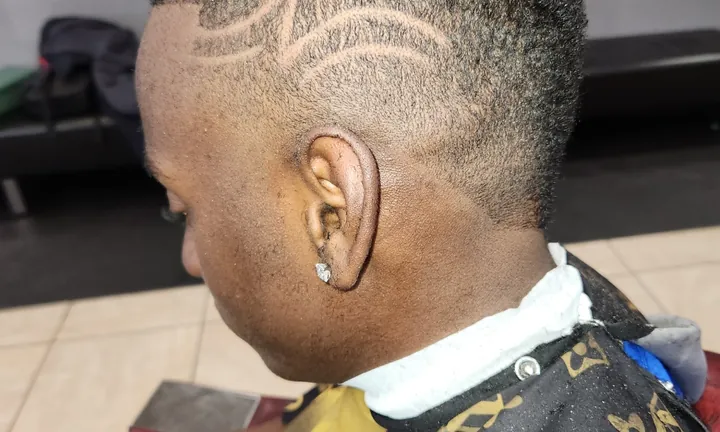
Look at a fade from the side and follow the line where the short hair meets the long hair. On most fades that line runs level around the head. On a drop fade it dips behind the ear and curves down toward the nape, following the shape of the skull. That one curve is the whole difference, and it changes how the cut looks from every angle.
The direct answer: a drop fade is a fade whose line drops behind the ear instead of staying straight, so the back of the head is faded lower than the sides. It is cut as a fade at $30 at Lilacroix Barbers in Laurelton. Below is how it compares to the burst, low and mid fades, which versions exist, what to put on top of it, and how to keep it.
What a drop fade is and how it is built
A drop fade is any fade, low, mid or high, where the top of the blend curves downward behind the ear and lands lower at the nape than it sits at the temple. The sides are faded at one height, then the barber lets the line fall as it passes the ear, and the back of the head keeps more length above the drop.
The reason it works is anatomy. The skull curves in behind the ear and out again at the back, and a straight fade line cuts across that curve. A drop fade follows it, so the cut looks balanced from the side and from behind, and the back of the head looks rounder rather than flat. On dense coily hair the effect is strongest, because the curve shows up as a clean arc of dark hair over skin.
How the barber builds it
The barber sets the lowest guard, usually a 0 or skin, at the sideburn and runs it back to the ear, then lets the guide line fall as it passes behind the ear toward the nape. The next guard up, a 1 or 1.5, follows the same arc a little higher, then a 2, then the lever work that erases the lines between them. The nape is tapered or blocked, the top is cut to length, and the line up finishes it. The skill is in keeping the arc the same on both sides of the head, which is why a drop fade from a good chair looks the same in every mirror and one from a home clipper does not.
Drop fade vs burst, low, mid and taper fades
The drop fade is defined by the shape of its line, not its height, so it is best compared by where that line goes.
| Cut | Shape of the line | Behind the ear | Nape | Looks sharp for |
|---|---|---|---|---|
| Drop fade | Level at the sides, curves down behind the ear | Drops toward the nape | Faded low | About 2 weeks |
| Burst fade | Half circle around the ear | Curves up and fades out | Left longer | About 2 weeks |
| Low fade | Level, about 1 inch above the ear | Stays level | Faded at the same height | 2 to 3 weeks |
| Mid fade | Level at the top of the ear | Stays level | Faded at the same height | 2 weeks |
| Low taper | Only the sideburn and nape | Untouched | Tapered 1 inch | 2 to 3 weeks |
The burst fade is the one people confuse with the drop, and the difference is the direction of the curve. The burst curves around the ear and leaves the nape long, which is why it suits a mohawk. The drop curves down past the ear and fades the nape low. Our burst fade guide covers the other side of that choice, and the low taper guide covers the option that keeps the most hair.
Drop fade variations: low, mid, high, skin and taper drop
The drop can start at any height, and the bottom can be skin or a guard. Those two choices give you the main versions.
- Low drop fade: the line sits about an inch above the ear at the sides and drops to the nape. Keeps the most hair, grows out easiest, and suits locs, twists and waves.
- Mid drop fade: the line sits at the top of the ear before it drops. The everyday version, with clear contrast and three weeks of life.
- High drop fade: the line sits at the temple and drops steeply behind the ear. The most dramatic arc and the shortest life, about two weeks.
- Skin drop fade: any of the above taken to bare skin at the bottom with a foil shaver or razor. Sharpest for about ten days.
- Taper drop: a softer version where the blend finishes at a 2 or 3 and the drop is gentle, almost a low taper with a curve. Good for men who want the shape without the skin.
On coily hair the drop fade reads cleanest when the blend finishes at a 2 and the top is left dense. On looser curls the blend should finish at a 3 so the arc does not show every guard step.
What goes on top of a drop fade
The drop fade pairs with almost any top because the curve adds shape at the back where most tops are plain. In our chairs these pairings come up most.
Short crop or Caesar
Half an inch to an inch on top with a line up. The drop gives a simple crop a shape it would not otherwise have, and it is the version most boys and working men pick.
Waves
Sides at a 1 or 1.5 with the grain, drop fade at the back. The drop follows the wave pattern down the back of the head better than a level fade does. Brush daily and sleep in a durag.
Curly top, twists or sponge coils
One to three inches of defined curl on top, drop fade underneath. The curve behind the ear makes the curls look like they are sitting on a clean base from every angle.
Afro or high top
Length on top with a mid or high drop fade is a modern take on the high top. The drop at the back keeps the shape from looking boxy.
Buzz cut
A 2 or 3 on top with a drop fade below is the lowest maintenance drop there is, and the arc is the only detail, so it stands out.
Choosing the right drop fade for your face and hair
The drop fade suits round heads and round faces best, because the curve at the back adds shape where a level fade would flatten it. The height and the bottom guard are what you tune.
- Round face: a mid or high drop with height on top lengthens the face.
- Square face: a low or mid drop with rounded corners on the line up softens the jaw.
- Oval face: any version, including a high skin drop.
- Long face: a low drop with the top kept short so the head does not read taller.
- Flat back of the head: a drop fade is the best fade for this, because the curve creates the roundness the skull does not have.
By hair type: 4A to 4C coils take the cleanest drop, since dense hair hides the guard steps in the arc. 3A to 3C curls need the blend to finish at a 3. Thinning temples want the bottom at a 1 instead of skin so the thin spot is not exposed at the front of the arc.
How to ask your barber for a drop fade
Say drop fade, say the height, say skin or a guard at the bottom, and say what you want on top. Show a photo from the side and from behind, because the drop is a back of the head detail and a front photo does not show it.

- Low, mid or high drop fade.
- Skin, a 0 or a 0.5 at the bottom. Men who get razor bumps should ask for a 0 guard and no razor at the nape.
- The guard at the top of the blend: 2 on coils, 3 on looser curls.
- The top: length in inches or a guard, and sponged, brushed, picked or left.
- Line up: natural, squared or rounded.
The mistakes to avoid are asking for a burst when you mean a drop, letting the drop go so low that the back is almost bald, and leaving out the side and back photos. If you are unsure, ask for a mid drop with a 2 at the top; it is the version that is easiest to adjust next visit.
Styling a drop fade and the products that help
The fade needs nothing but a drop of oil so the short hair does not look ashy. The top is where styling happens, and the routine follows the texture.
For a crop or Caesar, damp the hair, work in a curl cream or a light water based pomade, and brush forward or sponge in circles. For curls and twists, a leave in conditioner on damp hair, a light gel for definition, and air dry. For waves, a light moisturizer and a brush morning and night. Heavy waxes and clays clump coily hair and flake white into the fade, so stay with creams, gels and water based pomades. A sulfate free shampoo once or twice a week and a satin lined durag at night cover the rest.
Drop fade maintenance
A drop fade looks sharp for about two weeks, because the arc behind the ear shows new growth sooner than a level line does. A line up at the halfway point stretches it.
| Visit | When | Price |
|---|---|---|
| Fade (drop fade) | Every 2 weeks | $30 |
| Line up between fades | Week 1 after the cut | $16 |
| Kids drop fade | Every 2 to 3 weeks | $20 |
| Beard trim and sculpt with the cut | With the fade | Call for pricing |
Between visits, moisturize the top, oil the fade after a wash, sleep in a durag, and keep household clippers away from the arc. A drop fade that grows out on its own softens evenly; one that gets touched up at home comes back with a notch that takes two weeks to disappear. The fade, the line up and the kids cut are all on our services page.
Get a drop fade at Lilacroix Barbers in Laurelton
Lilacroix Barbers is at 232-12 Merrick Blvd in Laurelton, Queens. Walk ins are welcome seven days a week, and you can call (718) 749-5800 to check the wait. Hours are Monday to Thursday 7:30 AM to 7 PM, Friday and Saturday 7 AM to 7 PM, and Sunday 7 AM to 5 PM.
The Q5, Q86 and Q87 stop at Merrick Boulevard and 233rd Street outside, and the QM63 and QM65 express buses stop there too. The fade is $30 and the line up is $16; the full list is on our services page.
Questions readers ask
What is the difference between a drop fade and a burst fade?
A drop fade's line curves down behind the ear toward the nape, which is faded low. A burst fade curves around the ear in a half circle and leaves the nape longer, which is why it suits a mohawk.
Is a drop fade good for Black hair?
Yes. Dense coils hide the guard steps in the arc, so the curve behind the ear looks clean, and the contrast between dark hair and skin makes the shape stand out.
How long does a drop fade last?
About two weeks before the arc softens. A $16 line up in week one keeps the hairline crisp between $30 fades.
Can I get a drop fade with waves?
Yes. The sides are cut at a 1 or 1.5 with the grain and the drop follows the wave pattern down the back of the head better than a level fade does.