Low Taper Fade for Black Men: What to Ask For and How It Grows Out
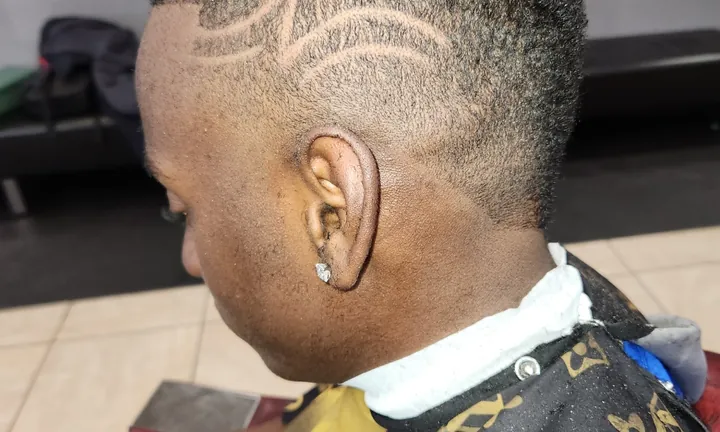
The low taper fade is the cut most men walk into our Laurelton shop asking for, and most of them describe it a different way. Some call it a taper, some call it a low fade, some just point at the back of their neck and say clean this up.
Here is the short version. A low taper fade takes the hair at your sideburns and neckline down close to the skin, blends it up about an inch, and leaves the rest of the sides and the top alone. On our price list a taper is $25 and a fade is $30. Below is what to ask for, which textures it suits, the mistakes that ruin it, and how it grows out over two weeks.
What a low taper fade is on coily and curly hair
A low taper fade is a gradual blend that starts just above the ear and at the nape, climbs no more than an inch or so, and leaves the rest of the head at its natural length. The word low tells you where the blend stops. The word taper tells you it only touches the edges, not the whole side of the head.
That matters on coily hair. A full fade wraps around the whole side and back of the head and ends in a line. A low taper keeps the sides, so your 4C or 4A texture stays visible from the front and the cut reads as neat rather than shaved. On tight coils the jump from skin at the sideburn to dense hair an inch above it looks sharper than it does on straight hair, which is why the low taper photographs so well on Black men.
Low taper, low fade, high taper and skin fade
- Low taper: blend at the sideburns and neckline only, about one inch high, sides keep their length.
- Low fade: the blend runs the whole way around the head at ear level and the sides come down to a 1 or a 0.
- High taper: the same idea as the low taper but the blend starts up near the temple and reaches two to three inches.
- Skin fade: any of the above taken to bare skin at the bottom with a foil shaver or a razor.
If you want to keep length on the sides for waves, twists or an afro shape, you want the low taper. If you want the sides gone, you want a fade. Our services page lists both, with a taper at $25 and a fade at $30.
Texture guide: 4C, coils, waves, locs and twists
The low taper works on every Black hair texture, but the guard your barber uses at the top of the blend changes with the hair. Tighter coils hide the transition, so the blend can be shorter. Looser curls and waves show every step, so the blend needs more room to breathe.
4C and 4B coils
Dense coils shrink close to the scalp, so a taper that climbs an inch can look like half an inch once the hair settles. Ask for the blend to finish at a 2 or a 3 guard rather than a 1 so there is a visible gradient instead of a hard edge. Coils also dry out fastest at the short faded edge, so a light oil on the taper after you wash keeps it from looking ashy.
4A coils and 3C curls
Curls with a visible pattern look best when the taper blends into a 1.5 or a 2 guard and the curls above it never meet a clipper guard. A guard run through the curls on top breaks the pattern. Ask for shears above the taper.
360 waves
Wavers want the taper tight and the sides at a 1 or a 1.5 guard with the grain so the pattern keeps rolling into the blend. The low placement is the right one here, because a high taper would cut the wave pattern off at the sides. Brush right after the cut while the hair is still damp.
Locs and twists
A low taper under locs or twists cleans the perimeter without touching the style. The barber tapers the sideburns and the nape with a 0 to a 1.5 guard and leaves everything above the ear alone. Starter locs and two strand twists sit well over it because the taper does not expose the parting pattern the way a high fade would.
Face shape fit
The low taper flatters almost every face because it changes very little about the silhouette. What you decide is how much height stays on top, and that is where face shape comes in.
- Round face: keep one to two inches of height on top and a tight low taper so the head reads taller than it is wide.
- Square face: a low taper with a soft, slightly rounded line up balances a strong jaw. A hard box line up on an already angular jaw can look severe.
- Oval face: anything works. This is the face that can take a skin taper, a hard part and a sharp line up all at once.
- Long or oblong face: keep a little more length on the sides, blend the taper only up to a 2 guard, and do not stack height on top.
- Heart or diamond face: a low taper is better than a high one because it leaves fullness near the temples, where this face is narrowest.
If you are not sure which shape you have, your barber can tell you in the chair. The safe call is almost always to keep the taper low and adjust the top, not the other way around.
Styles from the shop: waves, line up, twists, beard
Most of the low tapers we cut fall into five styles, and each one asks the barber for something slightly different at the top of the blend.
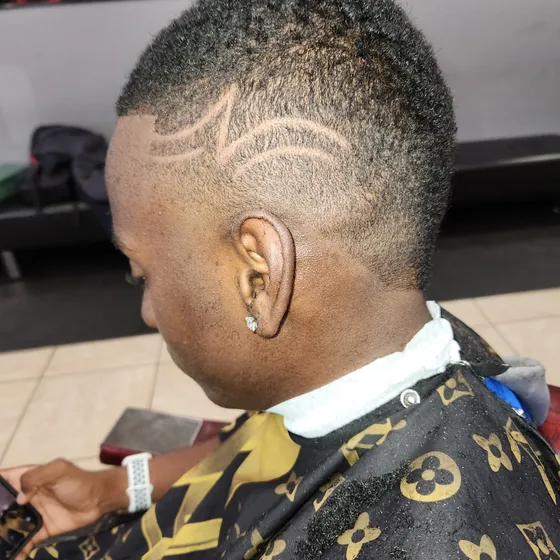
Low taper with waves
Sides at a 1 or a 1.5 with the grain, taper to skin at the sideburn and nape, line up squared or natural. Wavers tend to come back every 10 to 14 days.
Low taper with a line up
The classic Southeast Queens cut. A crisp hairline across the forehead, corners squared, temples tapered down to skin. On a Caesar or a short crop the line up is the whole look, and on its own it is $16.
Low taper with twists or a curly top
Two strand twists, finger coils or sponge twists on top with a low taper underneath. The taper should finish at a 2 guard so the twists do not drop straight into bare skin, which makes the top look like it is floating.
Low taper with a beard
The sideburn taper runs down into the beard so there is no break between the hair and the beard line. The cheek line and the neck line get shaped at the same time. The Cut and Beard package covers the haircut, line up, beard trim and razor beard line in one sitting.
What to tell your barber: guard numbers and where the taper starts
Say three things: where you want the taper to stop, what guard you want on the sides, and whether you want skin at the bottom. Everything else is a reference photo. The table gives you the words to use for the common versions.
| What you want | What to say | Guards involved |
|---|---|---|
| Low taper, nothing to skin | Low taper, blend it into a 2, no skin | 1 with the lever open at the bottom, up to a 2 |
| Low skin taper | Low skin taper, bald at the sideburn and the nape | 0 or foil shaver at the bottom, up to a 1.5 or 2 |
| Low taper for waves | Low taper, 1 on the sides with the grain | 0 to 1 to 1.5 |
| Low taper under locs or twists | Just clean the edges, low taper, do not touch the top | 0.5 to 1.5 at the perimeter only |
| Low taper with a line up | Low taper with a line up, square the corners | Taper plus trimmer on the hairline |
Bring a photo of someone with your texture, not just your style. A low taper on loose 3A curls and a low taper on 4C coils are different cuts even when the request sounds the same. Mention a cowlick, a scar or a thin spot so the barber can work around it. If you get bumps, say so, and he can keep a 0 guard on your neck instead of a razor.
Guard numbers in plain inches
- 0 guard, lever closed: about 1/16 inch or less
- 0.5 guard: 1/16 inch
- 1 guard: 1/8 inch
- 1.5 guard: 3/16 inch
- 2 guard: 1/4 inch
- 3 guard: 3/8 inch
- 4 guard: 1/2 inch
Opening the clipper lever adds roughly 1/16 inch to any guard, which is how the half steps in a blend happen.
Mistakes that ruin a low taper
The low taper is a simple cut, which is exactly why small mistakes show. These are the ones we fix most often on men who come in from another chair or from their own clippers.
- Taking it too high. Once the blend climbs past the top of the ear it is a mid taper, and the sides you wanted to keep are gone until they grow back.
- Going to skin on a thin temple. A skin taper exposes thinning temples. Blend into a 1 or a 1.5 instead and the temple looks full.
- Pushing the hairline back. A line up should follow your natural hairline, not create a new one further back.
- Running a guard through the curls. The top of a curly low taper is shear work. Clippers on top flatten the pattern.
- The wrong neckline. A blocked, squared neckline grows out with a ledge. A tapered neckline grows out invisibly. If you only come in once a month, ask for the natural neckline.
- Waiting five weeks. By then the taper is gone and the barber is starting over.
- Home clippers on the edges. One pass at the wrong angle leaves a notch in the taper that takes two weeks to grow out.
Say what you want, show the photo, and come back on a schedule.
How it grows out and when to come back
A low taper looks sharp for about two weeks and clean for three. Because the blend is short, a quarter inch of growth, which is about two weeks on most men, is enough to soften the edge.
| Week | What you see | What to do | Price |
|---|---|---|---|
| Week 1 | Skin at the sideburn and nape, hard line up | Brush, oil the edge, sleep in a durag | Nothing |
| Week 2 | Sideburns and nape fuzzy, hairline soft | Line up | $16 |
| Week 3 | The blend has filled in, sides look even | Taper or fade | $25 or $30 |
| Week 4 and after | A grown out crop with no taper | Full cut | $25 to $30 |
The rhythm most of our regulars settle into is a full cut every two weeks, or a cut and a line up alternating. A fade at $30 plus a line up at $16 covers a month of looking cut. Kids on the same schedule are $20 a cut. Between visits, brush the sides, moisturize the top, and leave the edges alone. The taper grows out evenly on its own.
Razor bump prevention on dark skin
Razor bumps happen when a cut coily hair curls back and grows into the skin instead of out of it, and they are more common on Black men for exactly that reason. The sideburn and the nape, the two places a low taper goes closest to skin, are where they show up.
Prevention starts in the chair. Ask for the bottom of the taper at a 0 or a 0.5 guard instead of a straight razor if your neck bumps easily. A guard leaves a hair tip just above the skin, which has a harder time curling back in than a razor cut tip below it. Ask for a clean guard, and a warm towel on the neck before the close work softens the hair so it cuts clean. Many men also find that going with the grain on the neck cuts the number of bumps they get.
At home, do not pick or squeeze. Use an alcohol free aftershave or a plain moisturizer on the taper, and a wash with salicylic or glycolic acid a few times a week may help some men keep the follicles clear. Skip shaving the area yourself between visits. Dark marks after bumps can take months to fade on dark skin, so it pays to prevent the bump rather than treat the mark. If the bumps keep coming back or start to scar, see a dermatologist, because that is a skin condition and not a haircut problem. We go deeper in our guide to razor bumps on Black skin.
Get your low taper at Lilacroix Barbers in Laurelton
Lilacroix Barbers cuts low tapers all day at 232-12 Merrick Blvd in Laurelton, Queens, and we are patient with first timers and kids. Walk ins are welcome, and you can call (718) 749-5800 to check the wait before you head over. We are open seven days: Monday to Thursday 7:30 AM to 7 PM, Friday and Saturday 7 AM to 7 PM, and Sunday 7 AM to 5 PM.
The Q5, Q86 and Q87 buses stop at Merrick Boulevard and 233rd Street right outside, and the QM63 and QM65 express buses stop there too. The full price list is on our services page.
Questions readers ask
Is a low taper fade the same thing as a low fade?
No. A low taper only blends the sideburns and the neckline about an inch up and leaves the sides long. A low fade runs the blend all the way around the head at ear level, so the sides come down short too.
How long does a low taper fade last on 4C hair?
About two weeks before the edges soften and three before the blend fills in. Coils shrink, so the taper can look shorter sooner than it does on looser curls. A $16 line up at the two week mark stretches it.
Can I get a low taper under locs or twists?
Yes. The barber tapers only the sideburns and the nape with a 0 to a 1.5 guard and leaves everything above the ear untouched, so the locs or twists keep their full shape.
Will a low taper fade give me razor bumps?
It can at the nape and sideburn if the hair is cut below the skin. Ask for a 0 or 0.5 guard instead of a razor at the bottom, keep the area moisturized, and see a dermatologist if bumps keep coming back.