Disconnected Undercut vs Undercut: How to Tell Them Apart and Ask for the Right One
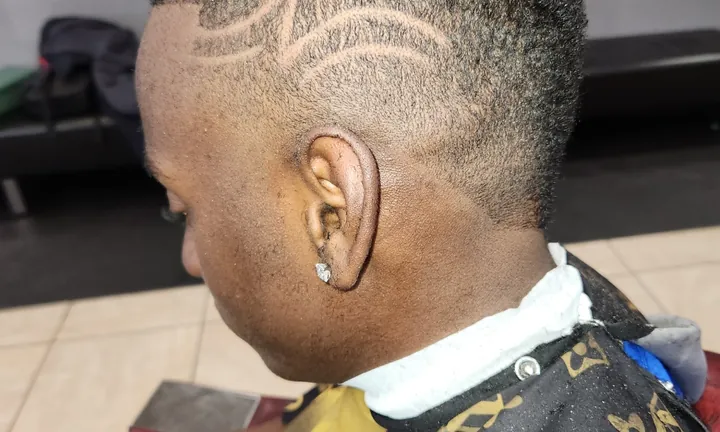
Disconnected undercut vs undercut is one of those questions that sounds like barber talk but changes the whole haircut. Say the wrong one and you leave with a hard line you did not want, or a soft blend when you wanted a statement.
The direct answer: a regular undercut blends the short sides into the longer top. A disconnected undercut does not blend at all, so the short sides stop and the long top starts with a clear gap. Here is how each looks, which hair types suit them and what to say in the chair.
Disconnected undercut vs undercut: the short answer
An undercut means the sides and back are cut much shorter than the top. The word "disconnected" tells the barber what happens where those two lengths meet.
In a regular, connected undercut, the transition is blended. The hair gets gradually longer as you go up, so the short sides roll into the top. In a disconnected undercut there is no transition. The barber clips the sides to one short length and leaves the top at its full length, and the edge between them stays visible.
Both are real choices and neither is wrong. Which one suits you depends on your hair type, how you wear the top and how much attention you want the cut to draw. If you have been wondering whether this whole family of cuts has passed its day, our post asking are undercuts out of style covers that side of it.
What does a regular undercut look like?
A regular undercut looks neat and smooth. The sides sit close to the head, and the top has length, but the move from one to the other is gradual. Someone looking at you from across the room sees one shape, not two.
Barbers usually build it with a guard number 1 to 3 on the sides, then use a lower guard or the clippers on their own at the bottom, blending up toward the top. The result grows out cleanly because there is no sharp step to show growth. It is the safer pick for a first undercut, for work and for anyone who wants something sharp without a statement.
We describe that softer approach in the guide to the blended undercut, including how far up the blend should reach.
What does a disconnected undercut look like?
A disconnected undercut looks like two haircuts stacked. The top is long, the sides are short and there is a clear shelf between them. The contrast is the whole point of the look.
The barber works the sides with one guard, often a number 1 or 2, or down to skin, then stops. The top is left alone, trimmed or textured with scissors. Because the sides are uniform, the shape reads bold from the front and the back.
This style is higher contrast and needs more upkeep. When the sides grow, the shelf softens and the cut loses the very thing that made it work. Expect a visit every two to three weeks if you want the edge to stay sharp.
Side by side: what changes
Use this table to compare the two. The differences are small on paper and obvious in the mirror.
| Feature | Regular undercut | Disconnected undercut |
|---|---|---|
| Line between sides and top | Blended, no hard edge | Visible, a clear shelf |
| Typical sides | Number 1 to 3, blended up | One short guard or skin, no blend |
| Top length | Short to medium | Medium to long |
| Grow out | Easy and soft | Shows quickly |
| Touch up | Every 3 to 4 weeks | Every 2 to 3 weeks |
| Feel | Clean and safe | Bold and sharp |
On our list the base prices are $25 for a haircut and $30 for a fade. If your sides go to skin, your barber will price it as a fade cut.
Which hair types and faces suit each one?
Both work on most hair, but coily and 4C hair behave differently from straight hair, and that changes which style looks best.
- Coily and 4C hair: a disconnected cut looks striking with a high top or twists, since the contrast is clear. A regular undercut keeps a natural afro shape easier to manage.
- Curly hair: a blend shows off curls and avoids a heavy top sitting on thin sides.
- Straight or wavy hair: disconnected works if the hair is thick enough to hold the top.
- Round face: a tall top with a clean side gives length. Either style works.
- Thinning hair: the blended version is kinder, because a disconnected look can make thin spots stand out.
If you are unsure whether the whole idea is right for you, undercut versus no undercut compares it with a plain all over cut.
How do you ask your barber for each one?
Use the right words and the right numbers. This list works for both.
- Say which one: "connected, blended undercut" or "disconnected undercut."
- Name the side length: a number 1, 2 or 3 guard, or skin.
- Say how high the short part goes: above the ear, to the temple or higher.
- Give the top length in inches, and say if it will be worn natural, twisted, brushed or combed.
- Ask for a line up and neckline to finish. Our line up is $16.
For the disconnected style, say "no blend" out loud. For the regular style, say "blend it up into the top." Those four words save most of the confusion we see.
How often do you need to come back, and is it still popular?
A regular undercut can wait three to four weeks. A disconnected one wants a visit every two to three. The shorter the sides, the faster they show growth.
People also ask if all of this is a passing thing. We answer that in are undercuts still popular, and our view is that both styles have a place, as long as you pick the one that fits how you live.
Between visits, moisturize the top and avoid pulling the hair into a tight band, which can thin the edges over time.
Book your undercut at LilAcroix Barbers
LilAcroix Barbers is at 232-12 Merrick Blvd, Laurelton, NY 11413. Call (718) 749-5800 or walk in; call ahead to check the wait. Hours are Monday to Thursday 7:30 AM to 7 PM, Friday and Saturday 7 AM to 7 PM, and Sunday 7 AM to 5 PM.
Tell us if you want a connected or disconnected undercut, and we will shape it with the right guard and finish it with a clean edge. Ask about our fade cut, our scissor cut for the top, and how to find us in our contact and directions.
Questions readers ask
Is a disconnected undercut harder to maintain?
Usually yes. The shelf between the sides and the top shows growth fast, so plan on a visit every two to three weeks.
Can I switch from a disconnected to a regular undercut?
Yes. Let the sides grow a little, then ask the barber to blend them up into the top. It takes one visit.
What guard number is best for the sides?
A number 1 or 2 is the most common. Go to skin for the boldest look, or a number 3 for a softer one.
Does a disconnected undercut work on 4C hair?
Yes. The contrast between tight sides and a high top or twists is clear, but keep the top moisturized so it stays strong.
Which one is better for a kid?
A regular blended undercut is easier. It grows out neatly and does not need a visit as often.